
A Film About Making a Film
The film begins where a tale has yet to become a book and ends where a dream is about to become a story. Between these two points, a modern Alice tries to make a film of her own. In her world, miracles exist, but access to them comes at a price. A jacket can become the Caterpillar's body, a street can turn into a garden of talking flowers, and a taxi can become a riverboat. Persuading an adult that an unfinished film deserves funding is rather harder.
What unfolds is both a journey through Carroll's familiar imagery and a comedy about the production of images. “Credits” connect the generative interface, a parent's bank card, the hope of finding an investor, and casino chips. The characters argue about nonsense, yet the most absurd rules belong to those who control the resources. The Rabbit is willing to invest in successful projects that no longer need his help. The world government promises to address the matter at its next meeting, without bringing the current one to an end. Alice's father tells her to grow up; the investor repeats the same formula.
On the surface, this is a dazzling fantasy of rapidly changing costumes. Beneath it lies the story of someone whose desire to make films is continually tested against other people's rules. Her answer is to keep filming.
Water Before the Story
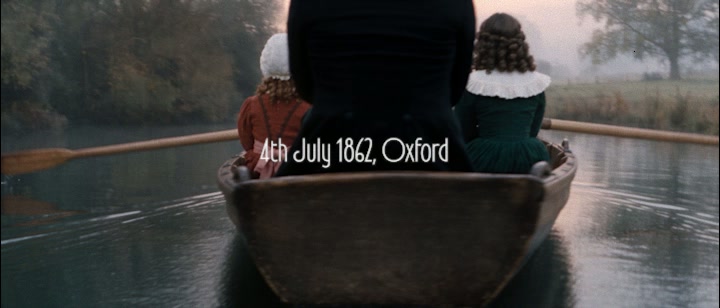
At first there is only the surface of the water: muted reflections of trees, architecture, and a peach-coloured sky. The world appears upside down before we see it the right way up. An oar enters the frame, cuts through the reflection, and traces spreading lines across the water. Then the wooden side of a boat, its passengers, and its stern come into view. The viewpoint glides close to the surface, rises, and retreats, gradually turning an isolated texture into a complete scene.
The opening inscription reads “4th July 1862, Oxford”. Gradually the boat resolves into a recognisable group: adults in dark clothing, three girls, pale collars, and blue, green, and brick-red dresses. The black-clad back of the nearest man occupies the centre and briefly blocks the view. Beyond him lie the smooth river, trees, and towers dissolving into the mist.
The light is soft and diffuse; the warm sky does not dispel the coolness of the water. The image suggests an illustrated historical pastoral, less a museum display than a memory already touched by idealisation. More significant than any specific painterly parallel is the way it is constructed: low contrast, airy depth, and the slow opening of space. Against this setting, the modern city will soon feel like an abrupt awakening.
The date points to the origins of Alice, but the shot does more than supply historical information: it establishes reflection and fluidity as the laws of the film to come. Everything that appears stable may be inverted, dissolved, or transferred to another environment.
A Request for Nonsense
An almost frontal close-up shows the storyteller over his listener's dark shoulder. He wears a black suit and waistcoat, a white shirt, and a small bow tie. His gaze moves between the children; his eyebrows lift slightly. His expression is restrained, but the corners of his mouth and the tilts of his head betray his pleasure in the intrigue he is creating. He promises “a very particular sort of tale”.
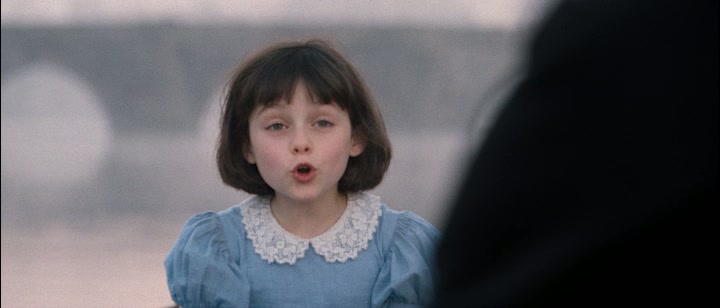
The reverse shot reveals a girl with a short, dark bob: a blue dress, a white lace collar, sleeves gathered at the shoulders. She is no passive listener. She asks outright whether the story will contain any nonsense. As the question ends, her face brightens into a smile. The blurred bridge arch behind her forms a pale circle without drawing attention away from her eyes.
We return to the storyteller, now in a wider shot with the girl in the foreground. He agrees and begins: “Once upon a time, there was a girl...” His hands retain their connection to the act of rowing; speech does not interrupt the journey. Towards the end, the frame rises, his face drops out of view, and the pale sky fills almost the entire image.
This is the film's first pact of meaning. The child asks for strangeness, rather than moral instruction or useful knowledge. For now, the adult accepts her terms. Later, other adults will respond in exactly the opposite way. The close-ups are edited with a simple, trusting rhythm: question, glance, answer. That simplicity makes the relationship believable before the world's laws begin to break down.
“Rolling.” Alice on the Other Side of the Camera
The face of a modern, fair-haired Alice emerges from the pale haze. She holds a phone horizontally, confidently, with both hands. She wears a beige cap, a dark fitted jacket with wine-red lapels, a white shirt, and striped cuffs. This is no conventional storybook girl's costume: it combines vintage dress, schoolroom discipline, and an independent urban style. “Rolling... Action!” translates the literary “once upon a time” into the language of a film set.
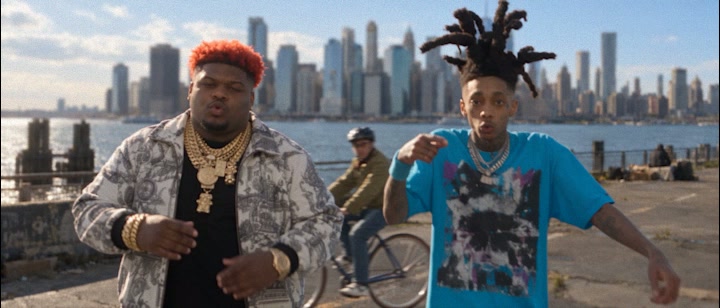
Two young men perform against the water and the Manhattan skyline. One is stocky, with short, vivid red hair, a pale patterned jacket, and several gold chains. The other is thin, wearing a saturated turquoise T-shirt, with his hair rising in tall strands. Their silhouettes contrast bulk with verticality. Arms and bodies move to the rhythm of the performance.
A brief insert turns the cityscape upside down; movement blurs the horizon before the image rights itself. For an instant, the film itself loses its sense of up and down. The inversion belongs to its visual language and needs no everyday explanation. It rhymes with the reflected world of the opening shot and anticipates the fall.
The performers exchange glances. One asks the other what is wrong. A fast, blurred swing of the viewpoint reveals the other side of the shoot: Alice stands beneath an overpass, framed by both men's shoulders. Behind her are concrete supports, graffiti, belongings, and makeshift shelters along a wall. The grand city skyline and the unglamorous space beneath the bridge turn out to be two sides of the same location.
A significant social tension emerges here. The image Alice hopes to make promises freedom and scale; the conditions of its creation are more cramped and impoverished. Harsh daylight, gleaming chains, and open blue sky give the scene the energy of a music video, but the reverse angle brings the labour of production back into the frame.
The Last Take That Was Already the Last
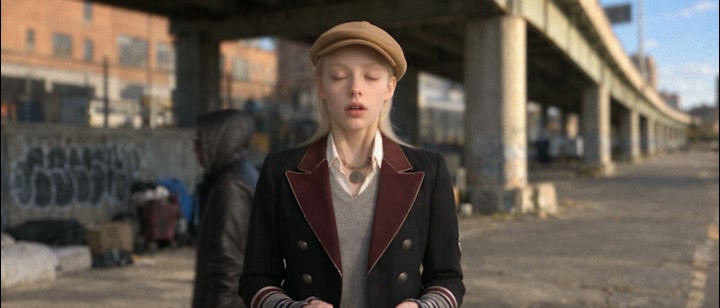
Alice first appears closer: a serious face, her phone lowered, her lips almost still until she briefly asks to try again. The edit then moves between the performers. With a smile and a tilt of his head, the red-haired man reminds her that she already promised “one last time” last time. The thin man spreads his hands, pointing out that her father has cut off her funding.
A medium shot places Alice beneath the long perspective of the overpass again. Against the heavy concrete, her small figure seems stubbornly composed. She does not throw a tantrum: she briefly goes still, then speaks with increasing determination. Her answer is: “I don't care. I'm finishing this film, so come on.” The phone she raises at the end becomes an action, rather than a mere prop: the argument ends with a return to work.
Two essential traits are established before the fantasy begins. First, she depends on others: on performers, money, and her father's patience. Second, she sees the film as a commitment to herself. Her composed, almost formally tailored jacket supports her position as director, while the cap softens her seriousness. She is trying on a professional role before her surroundings are ready to acknowledge it.
A Screen Within a Screen
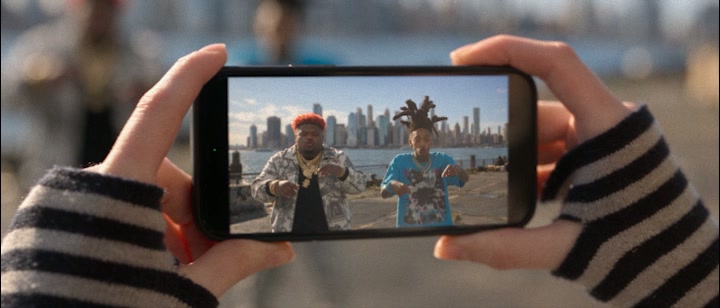


The camera moves behind Alice's shoulder. Close to us are fair hair, hands, and striped sleeves; ahead are the performers, repeated on the phone's screen. A gradual approach enlarges the device. The outside world becomes increasingly blurred, while the miniature image within the frame remains legible. A visual paradox emerges: the image seems more definite than reality itself.
In the rap, Tweedledum and Tweedledee quarrel over a rattle in the language of a diss. Carroll's verbal nonsense moves into a contemporary musical genre: the familiar pair become contestants in a rap battle, with Alice directing their performance.
The onscreen performance briefly fills the whole frame. Then comes an extreme close-up of Alice's eyes, with tiny rectangular reflections inside them. The film shifts its emphasis from what she films to how she looks. We enter her room before we see the room as a whole.
A video creation interface is open on the laptop. The familiar performers now hold round metal objects resembling frying pans and saucepans. The software does more than store the footage: the image becomes material that can be changed. An insert of the “GENERATE” button abruptly alters the scale. Its acid-yellow rectangle against a graphite background is the passage's most unmistakable colour signal. “Out of credits. Top up.” cuts short the promise of infinite possibilities.
Wearing large silver headphones, Alice looks over the laptop. The focus gathers on her eyes; her brows draw together. She states that she has run out of credits. A close-up then shows a finger pressing the keyboard. The magical portal proves to be a paid interface, and the dramatic antagonist first takes shape as a restriction on access.
A Conversation at Home About Growing Up
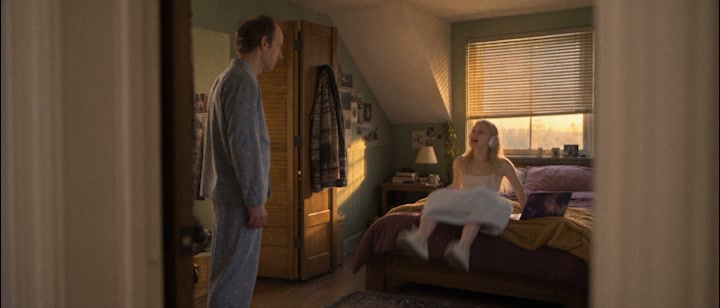
A wide shot establishes a small room: a bed beneath the window, warm stripes of light from the blinds, plants, pictures on the walls, and assorted fabrics. Alice sits on the bedspread with her laptop. Her white loungewear and loose hair remove the public armour of the previous scene. She turns her head when her father calls.
Her father is revealed from the bottom up: legs, pale patterned pyjamas, then his face. His entrance presents a figure of authority, but the pyjamas make that authority domestic rather than monumental. He asks whether she has bought credits with his card again.
A rapid sequence of reverse shots follows. Alice looks up at him and promises to repay the money after winning the festival. Her father responds with a direct prohibition. She treats future success as a fact, while he speaks of a present expense. Their argument unfolds across two different understandings of time.
Both are visible through the doorway. Her father stands on the left; Alice moves towards the edge of the bed, turns her whole body towards him, and gestures. The doorframe turns their conversation into a small domestic stage; the distance between them remains palpable.
For several seconds, her father stays in the doorway. He demands that she focus on college and “grow up”, then leaves. There is no reconciliation. The room's warmth does not match its emotional atmosphere: golden light promises comfort, while the staging leaves the girl alone.
The scene gives no reason to turn the father into an absolute villain: this is a recognisable argument about money. Yet the film presents it through his daughter's eyes. Her white clothing, headphones, and laptop make her both vulnerable and enclosed within her work. Here, “grow up” means abandoning the dream; the Rabbit will later repeat that substitution almost word for word.
A Tear Becomes a Space
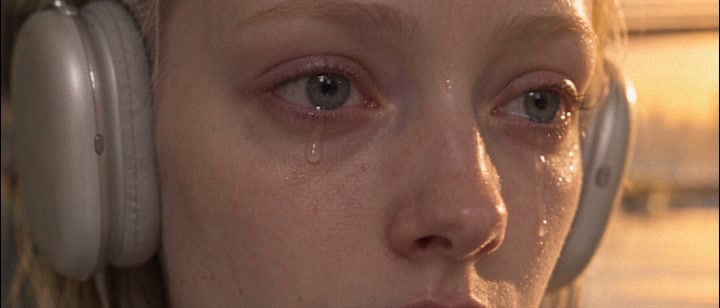
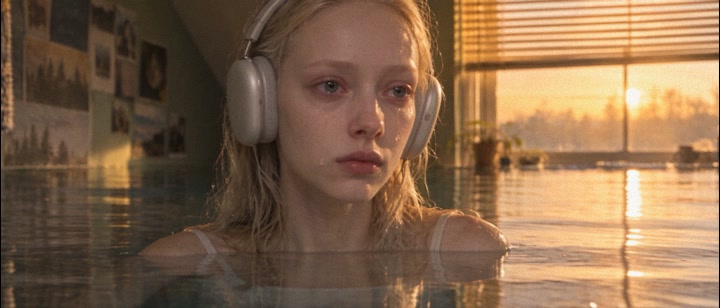
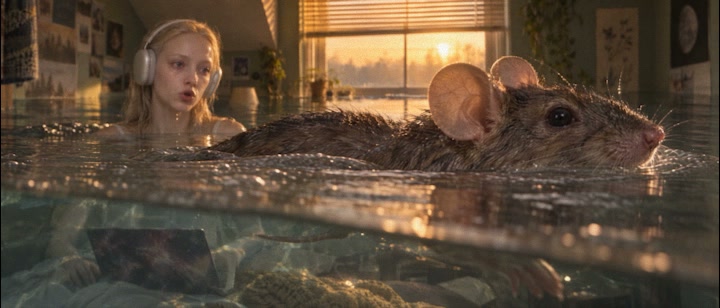
The close-up lingers on Alice's face. A single tear travels down her cheek. Her body is not convulsed by sobbing: she looks ahead without moving, and that restraint makes the small movement of water especially noticeable. Then the camera draws back. A level surface appears below, rising towards her shoulders. The room remains the same, but it is now flooded.
The miracle is achieved through scale, rather than a sudden change of scenery. The same warm band of window light now stretches across the water. Light gives her state of mind a physical form: private hurt has become an environment that reflects the window and surrounds her body. The headphones remain on her head; ordinary modern life persists even at the height of absurdity.
A swimming mouse appears before the camera. First we see wet fur, an eye, and a backlit ear. As the frame opens out, Alice emerges behind it. The waterline divides the image: faces and golden reflections above, the room's objects below. The mouse dominates the foreground. Perspective intensifies the disproportion between animal and room, preventing any familiar scale from reasserting itself.
Her remark about how silly it would be to drown in her own tears combines a literal image with self-irony. It is a direct narrative echo of Carroll's pool of tears. The scene's strength lies in its refusal to make Alice explain her feelings first: the architecture of an emotion becomes visible before any commentary.
The Mouse Crosses the Story's Boundaries
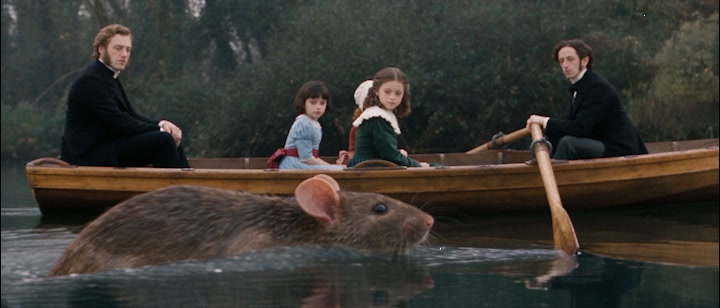
The second adult in the boat, dressed in black with a white collar, asks the storyteller whether he is making it up as he goes along. His expression falls somewhere between curiosity and friendly disbelief. The question applies both to the tale and to the construction of the film itself.
A wide side view of the boat follows. The mouse swims along its side in the foreground. It has crossed from the flooded room into the historical frame without an explanatory transition. The passengers turn their heads to follow it. The camera travels with this horizontal procession, bringing the animal and the passengers into a single composition for comparison.
Two girls wear brick-red and green dresses. Their costumes frame their faces in white: a bonnet for one, a broad collar for the other. Mouths open; eyes widen. Their reactions are not identical: concentrated observation comes first, followed by almost simultaneous amazement.
The girl in blue rises in the boat. Her hem, red sash, and moving torso make her more active than the seated figures beside her. With obvious pleasure, she demands: “I want more nonsense!” The child does not fear a breach in reality; she requests it.
This is one of the film's crucial turning points. The historical frame ceases to be a safe level “above” the fiction. What has been narrated can already swim up to the narrator. This mutual permeability prepares the way for the taxi on the river and the Rabbit in the final garden.
The Caterpillar in the Club
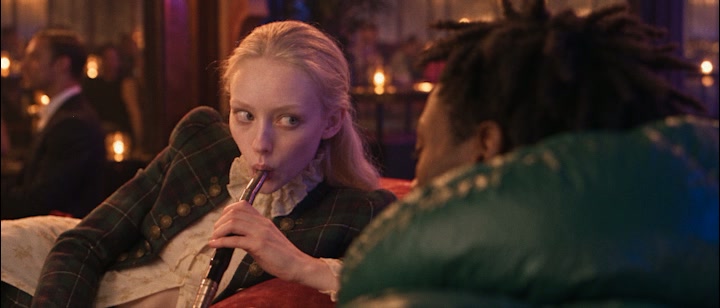
The edit takes up the child's wish almost word for word. Reclining on a soft red surface, the modern Alice says: “I want more nonsense. And money.” The addition turns an aesthetic need into a production need. She still wants wonders, but now she knows their price.
In a dark checked jacket and a blouse with a high lace collar, Alice gives her companion a sidelong look. Her posture is relaxed, her gaze appraising. Historical details of dress have been placed inside a nightclub. Small warm lights glow behind her, while violet and blue sources slice the space with colour.
The reverse shot reveals a man in an enormous glossy green jacket. Inflated segments surround his head, and his arms almost disappear within its bulk. He tells her about a Rabbit who supposedly invests in films. As he raises a hand, the supple gesture contrasts with the jacket's immovable mass. This is a modern Caterpillar, and the costume makes that identity legible before the body is fully revealed.
Holding the hookah mouthpiece, Alice asks what kind of films interest the investor. Her gaze sharpens. The answer is “Promising ones.” Alice exhales smoke, declares that her film is just that, and demands an address. Her companion leans back and points her in the right direction; the Rabbit is always late for something.
The scene is staged as a conversation about a useful contact in a private club. Carroll's adviser becomes someone who knows people. The emerald jacket, red surface, and purple light form a lush complementary palette. Its excess is deliberately far removed from the modest bedroom: Alice enters a world where everything promises access and pleasure, yet practical help always belongs to the next person along.
A Mushroom, a Lengthening Neck, and a Royal Vision
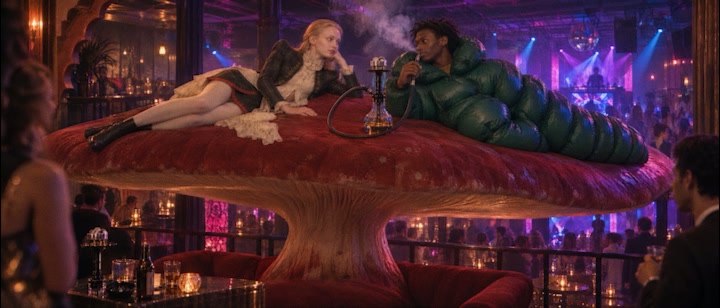
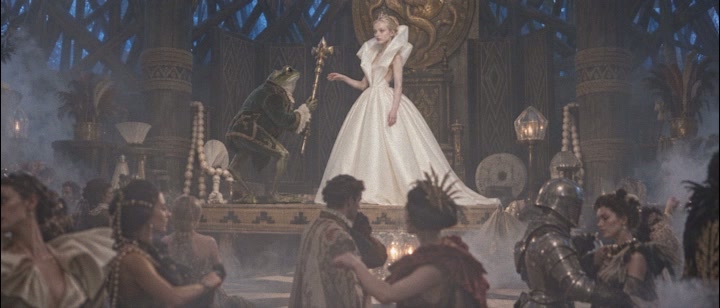

Alice lifts her chin and looks up. Soft light falls on her face; blue shimmers in the background. A wide shot reveals how the scene is arranged: both companions lie on the enormous cap of a mushroom. The Caterpillar's green segmented body stretches along it. Furniture, costume, and creature become a single sculptural construction.
Alice's profile moves against a starry, almost cosmic background. She exhales upwards; her neck visibly lengthens, placing her face unusually high above the collar. Smoke fills the image and becomes the transition. The body's transformation begins with an ordinary gesture: tilting the head back.
A courtly vision emerges through the smoke. A pale female figure in a long dress with a large, high collar stands on a dais before a throne. An elaborately dressed creature with a frog's head bows before her. Below, a moving crowd of costumed courtiers presses together, including a figure in armour. The cool blue upper reaches of the hall and the warm details of the costumes create a theatrical, fairytale depth.
The brief vision leaves the woman's literal identity open. What matters more is the ceremony itself: formal recognition, luxury, the attention of the court. For a heroine waiting for festival success, the image becomes a fantasy of her own triumph.
An abrupt enlargement of the Rabbit's eye opens out to reveal the full figure of a herald above the city at night. He wears white and red decorated with hearts, a lace collar, and carries a trumpet and a scroll. From eyes to costume, from costume to panorama: another rapid shift of scale. The Rabbit first appears as an emblem; only later will he become a businessman she has to chase.
A Fairytale Dress on the Pavement
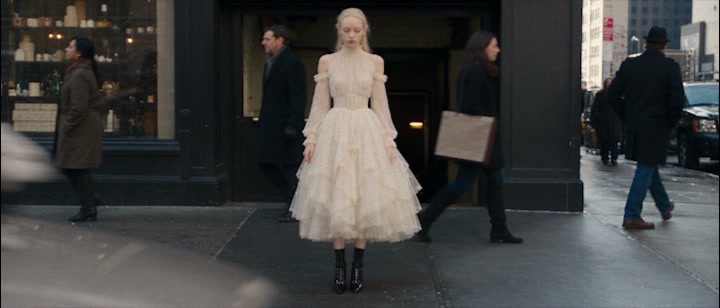
Alice stands before a dark city façade in a cream dress. It has a high neckline, a translucent upper section, bare shoulders with separate sleeves, a defined waist, and a layered skirt. Black shoes connect the airy garment to the asphalt. People in ordinary dark coats pass around her, while a car blocks the lower part of the composition.
The frontal wide shot holds long enough for us to feel the mismatch of tempos: Alice surveys her surroundings and chooses a direction, while the city is already moving. She breaks into a run. The camera retreats ahead of her. Pedestrians obscure parts of the frame; her movement is not given the immaculate space of a catwalk.
The action moves into a shop-window reflection. The frame of the glass lies diagonally, giving us an indirect view of the street. The Rabbit races through the reflection, followed by the white dress. This is more than an attractive cutaway: the film once again shows an event through a surface, as it did earlier through water and a phone.
The contrast between costume and setting recalls a fashion photograph in which the dress must appear as an impossible visitor to everyday life. Here, though, the clothes also describe Alice's predicament: to obtain money, she has to run in an outfit designed for stillness, display, and ceremony. Beauty becomes a physical inconvenience.
A Pitch on the Run
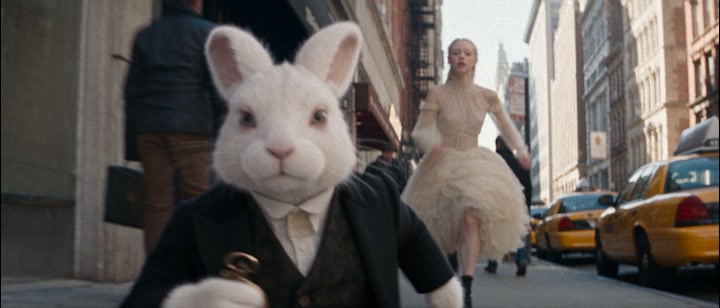
A lateral tracking shot follows the Rabbit in his dark suit. Alice reaches towards his back; they cannot establish a stable conversational distance. He maintains his direction and speed. A frontal camera moves ahead of the Rabbit, leaving Alice behind in the depth of the street. Whoever sets the pace determines the hierarchy.
The question about investing in films begins during the chase. The Rabbit's answer is “Walk and talk.” The following shots divide the conversation into running faces: Alice explains that her film is almost finished; the Rabbit, in profile, demands the point; she begins, “I just need—”. The request has no time to take shape.
A frontal wide shot reveals an open manhole, orange-and-white barriers, warning lights, and steam. The Rabbit dives down. Alice runs up, flings out her arms, balances herself, and stops at the opening. Her skirt catches the movement, spreading into a pale fan among the straight stripes of the barriers.
The camera movement during the chase is mainly horizontal; the obstacle suddenly introduces a vertical axis. This is an important directorial turn: a business conversation built on speed and efficiency leads quite literally to a fall. Alice wanted to finish her sentence; instead, she has to change worlds.
First Look Into the Hole, Then Jump
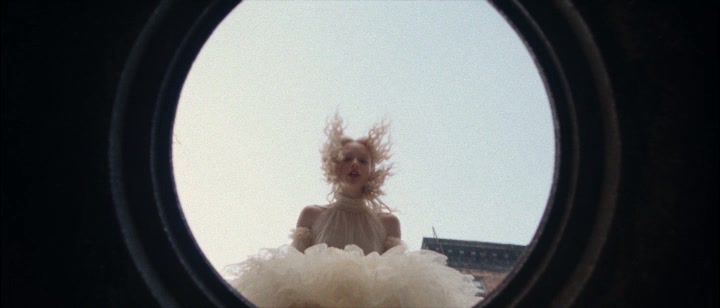
This short passage depends particularly on the order of its actions. From the darkness of the manhole, we see a bright circle of sky and Alice leaning over it. Her hair lifts; her skirt and face hang above the opening. As the viewpoint moves, the black circular frame disappears, revealing façades around her head. Perspective makes the architecture tilt and lose its stability.
“Curiouser and curiouser” turns an observation into the recognition of a new law. Alice is not falling yet: she examines the opening and makes a decision. Returning to the wide street view, we see her above the manhole, her arms spreading out again. Only at the end does her figure disappear downwards.
The film thus preserves her initiative. She has not simply been sucked into a nightmare or accidentally knocked off her feet. After a moment of surprise, she follows what she needs. The circle of the manhole can also be read as a lens: the person who began behind the camera now steps into the image's dark aperture.
Falling Through a Library
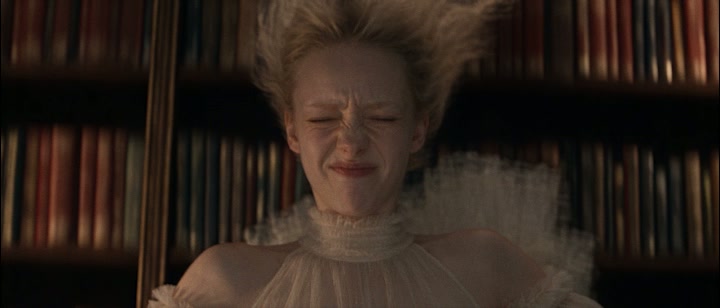
The cut leaves Alice facing the viewer but changes everything around her. Bookshelves move behind her; her hair stands upright, and light fabric rises at her shoulders. Her face remains relatively steady in the centre, so the fall is conveyed through the relationship between figure and background. First she opens her eyes wide and looks aside; then she grimaces, squeezes her eyes shut, and opens her mouth.
Dark winged silhouettes fly across the foreground. In the half-light they resemble bats: swift patches disrupting the stillness of the face. They cross in front of her and intensify the sense of a cramped, uncontrollable space. Book spines provide a vertical rhythm, turning a corridor of knowledge into a shaft.
“Ugh, not school again” brings the fantasy back to the conversation about education. The library does not become a solemn temple of culture here: for Alice, it is a recognisable form of imposed adulthood. Yet she is herself moving within a literary world. The irony is that she resists school through the resources of a book.
Gradually, the image approaches complete blackness. Darkness interrupts both the visible movement and our ability to judge where the depth ends. The next scene begins as another awakening.
A Flowerbed in the City's Wound
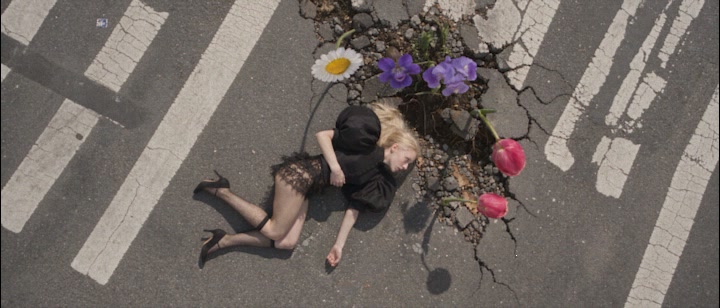
Alice lies with her cheek on the ground, her hair scattered beside her. The cream dress has disappeared. She now wears black, with very voluminous short sleeves and a lace lower section. She opens her eyes without yet lifting her head. Black fabric, pale skin, and rough earth create an almost graphic contrast.
An overhead view explains the space. This is no garden: she lies on a pedestrian crossing beside a split in the asphalt from which large flowers grow. White road markings cross the grey surface; a small island of earth disrupts their system. Alice turns and begins to prop herself up on one hand.
From above, she seems part of a strange ornament: the diagonal of her body, the stripes of the crossing, and the coloured flower heads. Yet the shot means the opposite of decorative smoothness. Imagination has not been given a park of its own; it has broken through a crack in the infrastructure. The image is more precise than the broad label “surrealism”: nature occupies the exact site of damage, and Alice finds herself on its level.
A Sung Lesson in Standing Still
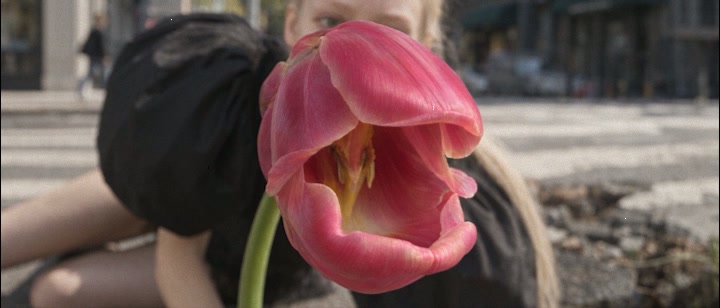
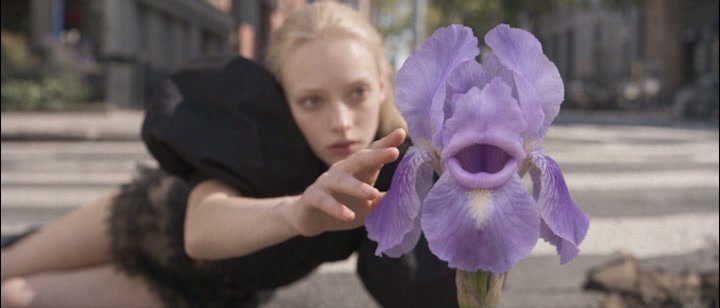
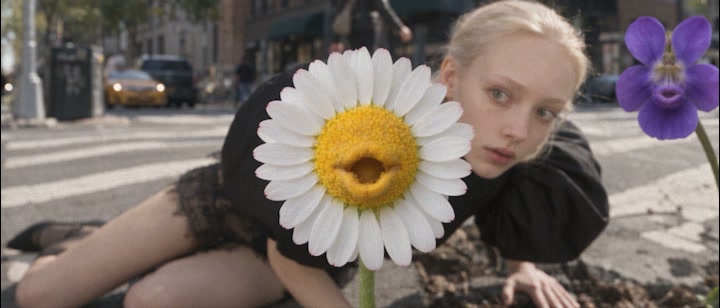
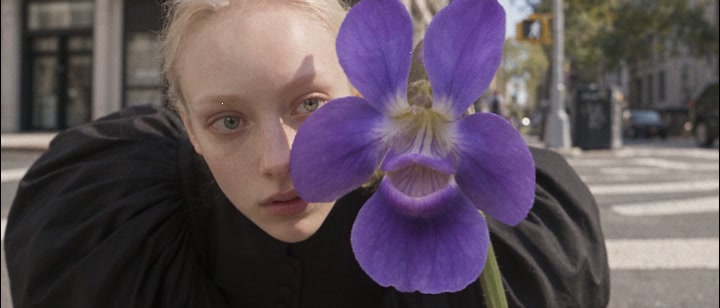
Four floral figures alternate like members of an ensemble. A reddish-pink flower with tulip-like petals opens its mouth; Alice remains behind it. A pale violet, iris-like flower takes up the song. She extends two fingers towards it, hesitating to make contact. A white daisy with a yellow centre comes to the foreground; Alice's face peers around its side. A darker violet flower occupies the centre, then turns into profile.
Botanical accuracy gives way to expression: corollas become faces, their centres mouths. Their scale and proximity to the lens push the human figure into the background. As the soloists alternate, Alice does more than register surprise. She looks intently, brings her face closer, compares the speaker with herself, and at times almost stops blinking.
The song develops an idea: you have to run as hard as you can to stay where you are, and twice as fast to get anywhere. The Red Queen's principle from Through the Looking-Glass is placed in the mouths of flowers and addressed to a modern Alice. The rhymed lines pass from one soloist to another, turning an abstract paradox into a small musical performance.
The construction of the scene reinforces the paradox. Creatures rooted to the ground sing; a girl already exhausted by running receives advice about speed. The saturated flowers appear against an almost neutral city, while Alice's black costume makes her a visual outsider to this little festive company. They are both a fairytale chorus and a mocking seminar on surviving competition.
Costume as an Instant Claim to Status
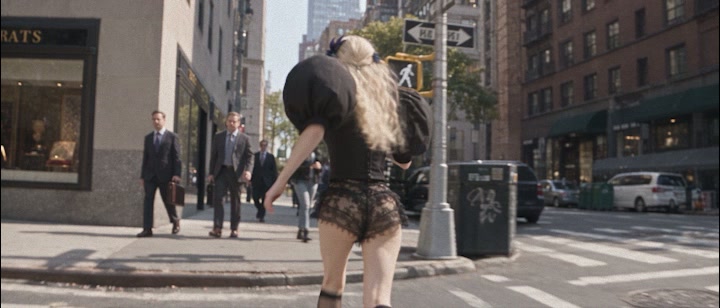
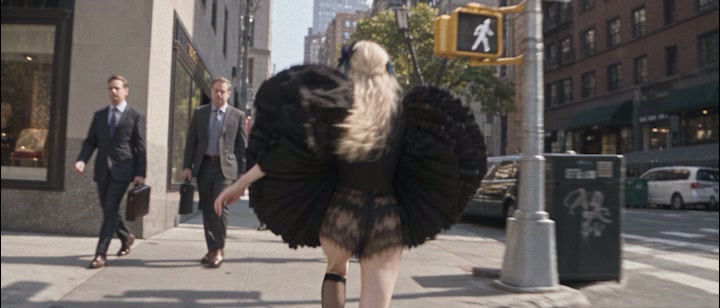
A low wide shot again shows Alice lying beside the flowers. She answers their extended lesson with a terse “Obviously.” Then she gets up: first onto her hands and knees, then quickly to her feet. The camera follows her from behind across the pedestrian crossing. After all these wonders, her task is unchanged: catch up with the source of money.
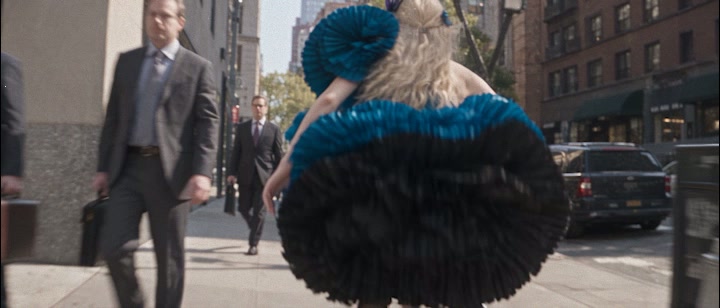
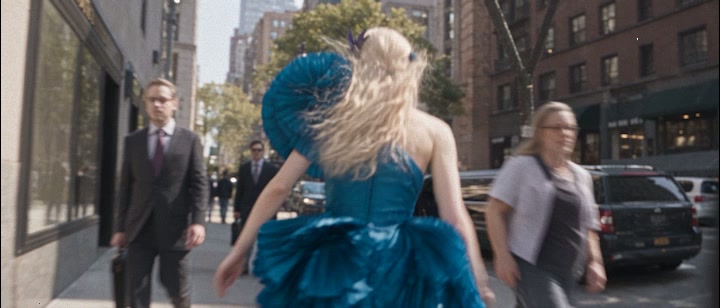
An important transformation follows. The black sleeves expand into large pleated fans, the fabric swells behind her back, then turns a vivid blue-turquoise. The result is an asymmetrical dress with a voluminous ornament at one shoulder and cascading folds down the skirt. This is no conventional “before and after” cut: the intermediate states show the actual process of changing form and colour.
Pedestrians continue to cross the frame. No special ceremony is arranged around the transformation. Everyday movement makes the impossible seem ordinary, and Alice herself barely pauses to take in her new appearance. A long black limousine waits at the kerb. She bends and gets inside; the dark doorway frames the bright fabric.
The dress can be read as preparation for an encounter with capital. The stark black street look gives way to ostentatious luxury. She seems instantly to acquire the “right packaging” for a conversation with an influential person. Yet the next encounter will show that a convincing appearance cannot break the closed logic of selection.
An Investor Who Wants a Film That Has Already Made Money
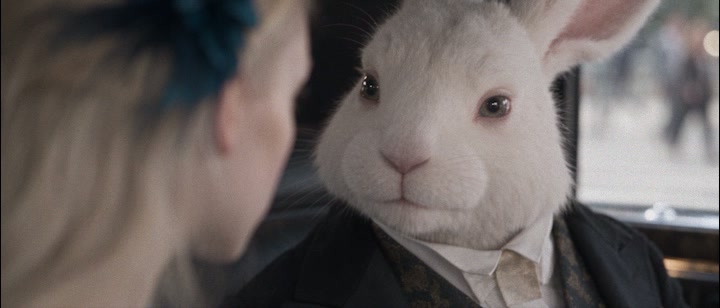
Black quilted leather, glass, and reflections dominate the limousine. Daylight enters through the windows; the city slides past their frames, but the main energy is concentrated in the faces. The turquoise fan of the dress occupies the space beside Alice's head, amplifying every small movement she makes. The Rabbit's white fur stands out sharply against his black suit and the dark interior.
Alice turns towards him, reminding him of the film. Expectation in her eyes gives way to surprise: he asks who she is. The Rabbit seems to recognise the subject, then immediately asks how much the picture has made. The small movements of his head and mouth are presented in conventional human dialogue editing. A fantastic creature behaves like a familiar functionary.
Alice explains that the film is not finished yet. The Rabbit suggests that she return once it has made money. She leans forward, raises her eyebrows, and replies: if the film were already earning, why would she need an investor? This is no helpless outburst, but a precise identification of a hole in his logic.
The Rabbit repeats the rule: he invests in successful projects; she needs to grow up. Alice's expression shifts from the strain of arguing her case to recognition. “My dad says the same thing.” The domestic scene returns in a single line, without a flashback.
The satire works because the form remains calm. The limousine does not become an attraction until the conversation is over. Clear, opposing close-ups allow an absurd condition to sound like a normal business principle. The Rabbit is more than simply greedy: he represents a system that demands results before providing the means to achieve them.
Reaching for an Opportunity That Slips Away
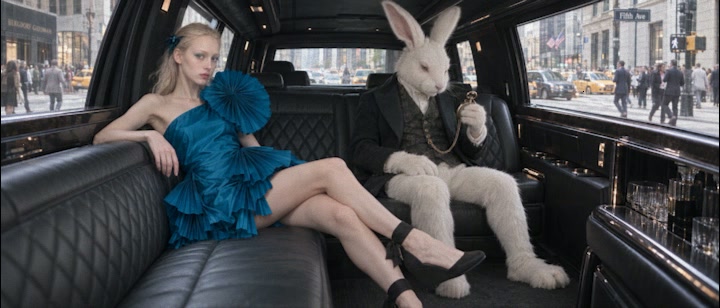
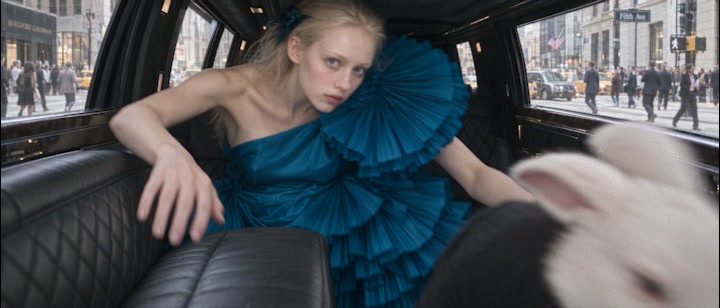
A wide shot reveals the entire arrangement of the interior for the first time. Alice sprawls on the long seat; the Rabbit is beside her with his pocket watch. He suddenly bolts and disappears at the exit. She immediately gathers herself: lifting her torso, bracing one palm against the seat, and reaching after him with her other arm.
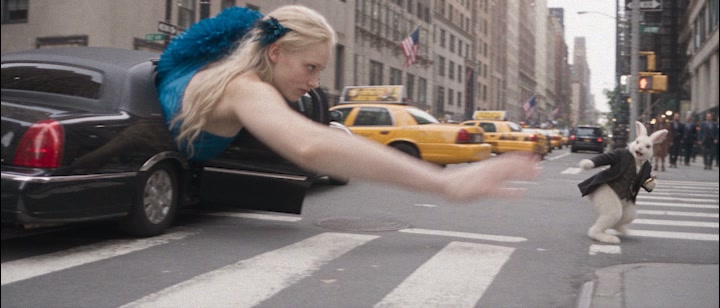
The camera is then outside. An implausibly elongated Alice protrudes through a window or opening in the limousine. Her body stretches over the crossing; her hands try to reach the fleeing Rabbit. This is more than a long arm: the relationship between person, vehicle, and distance has been deformed. A small white figure moves across the asphalt, while a large blue one hovers almost horizontally above it.
The scene is literal, and expressive for that reason: “reaching” an investor becomes a physical impossibility. It rhymes particularly well with the earlier lengthening of her neck. Then, her body stretched towards a vision; now it stretches towards a resource. In both cases, desire changes anatomy.
The financial meeting once again turns into a chase after transport. The conversation never reaches a conclusion: the Rabbit's movement physically replaces an answer, while Alice is left making an effort with nothing to support it.
A Taxi Sails Into the Nineteenth Century
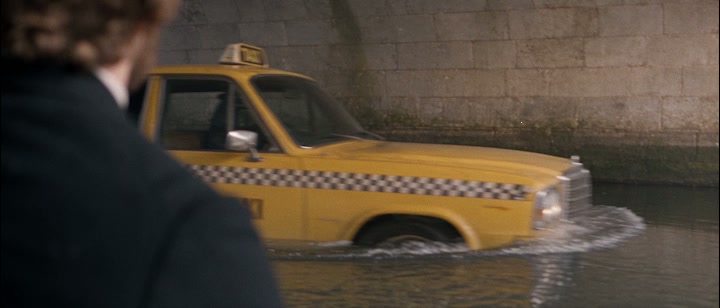
The Rabbit sits beside the open window of a yellow taxi. The camera draws back from his face, successively revealing the door with its chequered stripe, the body of the car, and the surrounding environment. The car is in the water beneath a stone bridge. A familiar urban object acquires an impossible means of travel; the reveal unfolds with an almost unflappable sense of order.
The Rabbit complains that the Duchess will have him executed. His reference to another authority puts his own confidence in the limousine into perspective: the one who has just refused Alice is himself late for something and afraid of someone.
Inside the taxi, we see a driver with a black bird's head and beak. Ahead, through the windscreen and the bridge arch, is the boat from the opening. The taxi passes it, leaving disturbed water behind. Through the car's side window, an adult and the girls can be seen waving after it.
The staging is built from nested frames: glass, bridge, distant light, boat. At the outset, the water reflected Oxford; now New York has literally been introduced into it. The bright yellow bodywork cuts through the muted green-grey palette of the historical scene. This is one of the film's most precise colour conflicts: modernity neither disguises itself nor acquires an aged patina, but passes through the past in its full colour.
The scene recalls the surrealist relocation of a familiar object to an alien environment. Its kinship with Magritte lies less in any single symbol than in the calm credibility of an impossible combination. Yet the movement, the transport farce, and the children's reactions make it more cinematically mischievous than the stationary paradox of a painted still life.
Two Responses to the Same Miracle
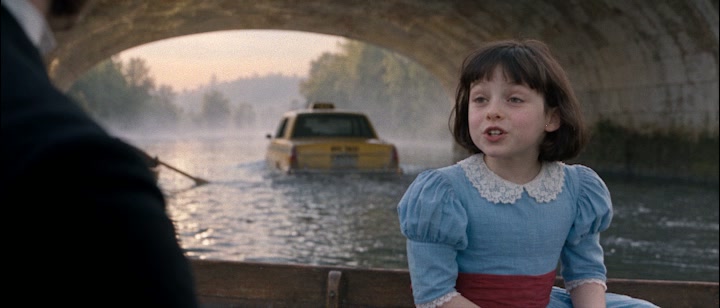
In the boat, the girl turns from the departing taxi to the storyteller. Her face first opens to astonishment, then to broad delight. “What splendid nonsense!” The taxi remains in the background beneath the bridge; the reaction is not severed from its cause. The framing is close enough to show her pleasure and wide enough to keep the miracle in the same shot.
The modern Alice sits beside the park, addressing the lens almost directly. Yellow taxis pass behind her, connecting this scene to the previous one. She now wears a white-and-blue outfit with a botanical pattern, broad lapels, and a thin red ribbon at the collar. Compared with her appearance in the limousine, the look is lighter and more formal.
Her message is pragmatic: the Rabbit has bailed, but someone else here may be able to help. For the girl in the boat, the miracle fulfils a wish. For the modern heroine, it is another delay in finding a solution. The edit joins these reactions without declaring either one right or wrong. This reveals the cost of authorship: the creator must see unfinished work behind the splendid nonsense.
Tea as a Government Meeting
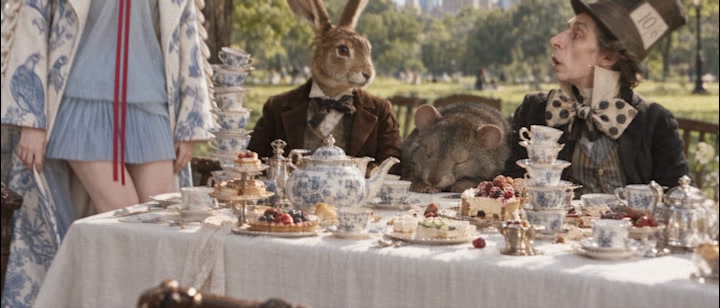
The camera begins with a pastry or cake, berries, icing sugar, silverware, and porcelain. The white tablecloth and cream join the blue pattern on the cups. As the table is revealed, an arrangement of objects becomes a social composition: an extravagantly laid table stands in the park, with the March Hare and the Hatter seated at it. Alice takes a place beside them.
The Hare, in a brown jacket and tie, turns towards Alice and announces that she is not allowed there. On the other side is the Hatter in a tall top hat, an enormous spotted bow tie, and a dark textured suit. The traditional “10/6” card is visible on his hat.
Holding a small cup with deliberately precise finger movements, the Hatter explains that this is a meeting of the world government. The scale of the claim is out of all proportion to the picnic setting. Greenery and city towers are visible in the distance; the park itself becomes a drawing room in the middle of a metropolis.
The white tablecloth and fine porcelain promise civility; the prohibition on Alice's presence exposes its exclusiveness. The blue pattern of her clothes almost matches the tea service. Visually, she belongs to this world, yet she is the one denied admission. The conflict between a harmonious palette and discordant relationships is especially fruitful: she is excluded not because she is “the wrong colour”, but because access is controlled by those who preside over the table.
The Bureaucracy of Meaningless Time
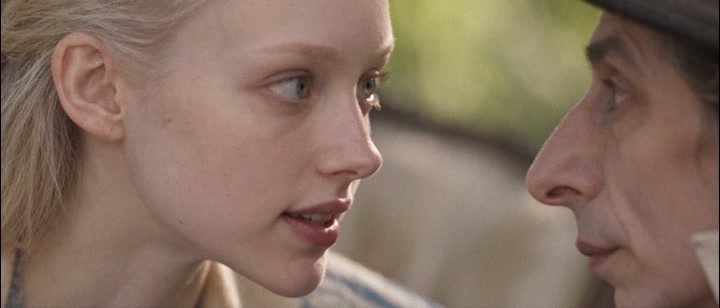
Alice swiftly turns the grand declaration into a practical matter: if they are the world government, they should give her free credits. The camera looks past the Hatter; an unsteady tower of cups rises beside her face. The fragile crockery appears as the material equivalent of a system held together by habit and elaborate conventions.
The Hatter replies that the matter will be discussed at the next meeting. He first looks down, then turns his eyes towards her and pivots. Suddenly their faces are almost touching in a profile two-shot. Alice asks when the next meeting will be. The answer: when this one is over.
The reduction in distance produces no intimacy. On the contrary, absurdity becomes an almost intimate imposition. Alice maintains a direct gaze and a firm mouth; he delivers evasion as though it were a reasonable explanation. Then she looks up and aside. Her attention shifts from another fruitless conversation to a new interlocutor.
With the Rabbit, money was locked inside the time of future success. Here, help is locked inside the time of the next meeting. The two mechanisms are identical: the necessary action is always possible later than Alice can obtain it. The film turns Carroll's philosophy of time into a satire on approvals and decision-making.
A Smile That Knows the Rules
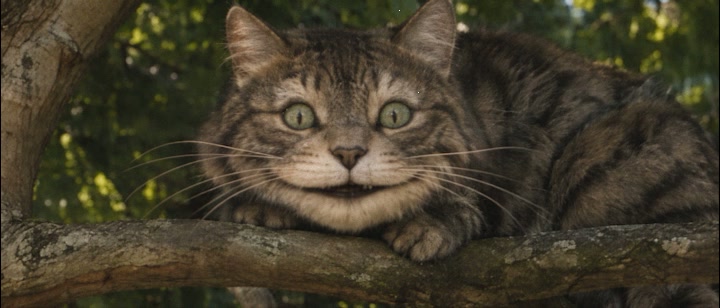
An upward movement along the trunk follows Alice's gaze and reveals a large striped cat on a branch. At first he is embedded in the foliage; a separate cut then brings his face closer. He lies low, paws in front of him, his green eyes calm. His smile opens too widely for an ordinary animal; the row of teeth looks emphatically human.
The textures of bark, fur, and patches of sunlight strive for naturalism. The impossibility is concentrated in a single detail: the construction of the mouth. The cat therefore needs neither bright colouring nor smoke. The most realistic exterior carries the most direct grotesquerie.
“They are all mad here” and the suggestion that she ask the King sound like a diagnosis and a new route. The Cat does not solve the problem, but he allows Alice to stop taking the previous refusals as evidence of her own inadequacy. If the rules are mad, ordinary logic can never fully refute them.
By the end, the camera is even closer to the smile. It becomes an independent graphic sign, although in this version the body does not disappear. This is an important distinction: the film draws on the Cheshire Cat's recognisability without needing to repeat every famous effect from other adaptations.
A King in the Palm of a Hand
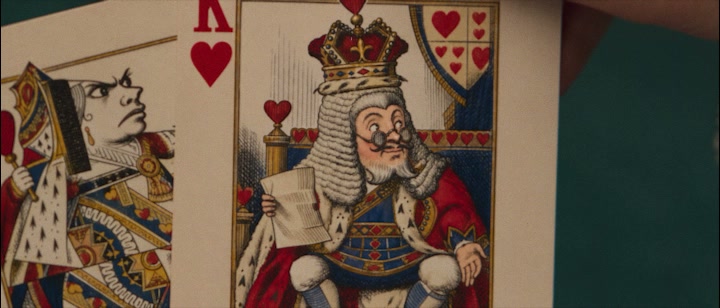
Following the Cat's advice, the film does not take us to a throne room. Instead, two playing cards appear in Alice's hands: the queen and king of hearts. Her other palm covers them from above, as though protecting a small, secret conversation. Green baize replaces the greenery of the park. The word “king” instantly shifts from social rank to an image on paper.
The figures on the cards address Alice; changes in their drawn faces turn static printing into characters. An extreme close-up shows her eyes. Their tense movement conveys the concentration of someone determined not to miss an opportunity. Back to the cards. An even tighter view of the printed faces.
She asks about credits again and receives agreement. What matters is the difference from her previous interlocutors: permission to act replaces postponement. The brief exchange does not dispel the scene's fairytale artifice, but it changes Alice's position. For the first time, her request does not return to her as a new obstacle.
Of all the figures of authority, this one is literally the smallest. Yet it is precisely that reduction which removes the distance. At home, the adult towered over the seated girl; in the limousine, the Rabbit dictated terms; at the table, the Hatter invaded her personal space. Now the king is in her hands. Scale becomes a dramaturgy of agency.
All In, and Humpty's Unmoving Face
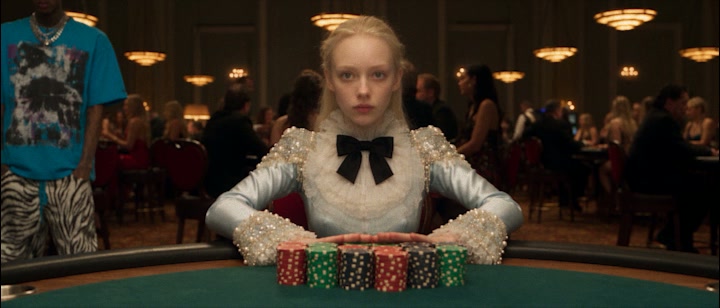
A frontal medium shot at the gaming table. Alice wears pale blue with white trim, substantial sparkling embellishments on the shoulders and cuffs, a high collar, and a black bow. The decorations produce a fine, cool glitter, separating her figure from the casino's warm surroundings. Before her stands a neat wall of coloured chips.
She places her palms in front of her, gathers her body, and pushes the chips forward. “All in” matches the action. “Royal flush” follows. The movement is brief, without an extended build-up: the desire accumulated through the previous scenes finally takes the form of a deed.
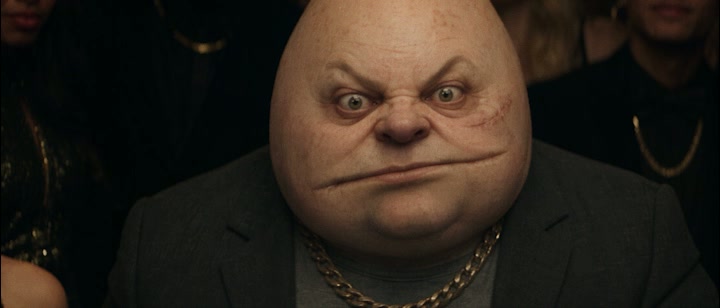
An insert of cards and chips gives way to a rising view of the opposite side of the table. A large figure sits there with an egg-shaped head, small, tense eyes, and a heavy mouth: an unmistakable variation on Humpty Dumpty. He wears a dark jacket and a gold chain and holds a glass. Smartly dressed visitors crowd around him. He takes a sip, then stares straight ahead without moving.
A brief reaction from three girls: smiles, interest, pleasure in the spectacle. A close-up of Humpty follows. His mouth is compressed into a crooked horizontal line; his gaze is heavy. This is a grotesque image of power distinctly displeased by someone else's good fortune.
Behind Alice stand the same performers from the waterfront, now in more formal dark-blue clothing. One raises a metal cooking vessel, an object that rhymes with the image on the laptop. A seemingly casual digital alteration from the opening minute returns as part of the shared world.
The announced “Royal flush” does not make the spread of cards a perfectly legible hand: the scene's verbal meaning is clearer than its game logic. The winning move matters above all as an action, while the transfer of winnings or the granting of credits remains offscreen. The ending will show that Alice intends to carry on working; the means of financing remain within an editing ellipsis.
After Luxury, a Bench
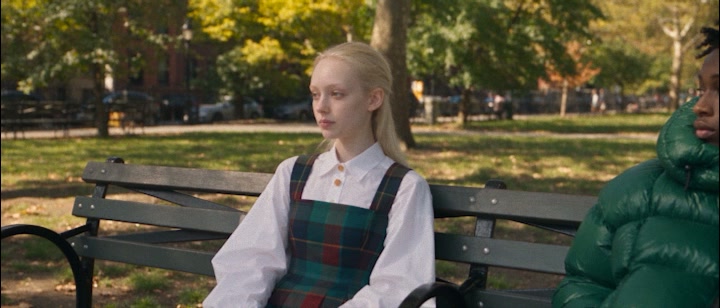
The cut takes us from the dense warmth of the casino into an open park by daylight. A wide shot shows a basketball court, its hoop, wire fencing, players, and a bench on the right. Alice and the Caterpillar occupy only a small part of the space. After the close views of faces and chips, this scale offers breathing room.
A two-shot on the bench. The Caterpillar retains his huge green segmented jacket, but it now looks almost like ordinary urban outerwear. Alice wears a white blouse and a green-and-red checked pinafore. Her shoulders are held close, her hands near her knees. The fairytale heroine has returned to a recognisable everyday appearance, retaining a pattern related to her jacket in the club.
He asks how things went with the King. Her answer, in short, is that the film will continue. Her companion's surprised disbelief throws her quiet confidence into relief. The financial details remain outside the conversation; the possibility of returning to work comes to the foreground.
The composition gradually concentrates on Alice. She tilts her head towards the light and shields her eyes with her palm. She says the film will probably be about taking down the world government. In context, this is a comic artistic proposition: her encounters with absurd intermediaries have become material for the next story.
The light is freer and calmer here than in her room. Golden foliage surrounds the figures, no longer confined to stripes from the blinds. At the beginning, others prescribed what adult life should be; now she chooses what to tell. Victory is expressed not through a triumphant pose, but through the ordinary possibility of sitting in the sun and imagining what comes next.
The Sky Becomes a Way Out of Someone Else's Dream
A subjective upward view: Alice's palm against blue sky and large pale-grey clouds. Her hand withdraws, leaving open air. The line about her future film continues over the changed image: speech maintains the connection with Alice while the camera is already gaining freedom from her body.
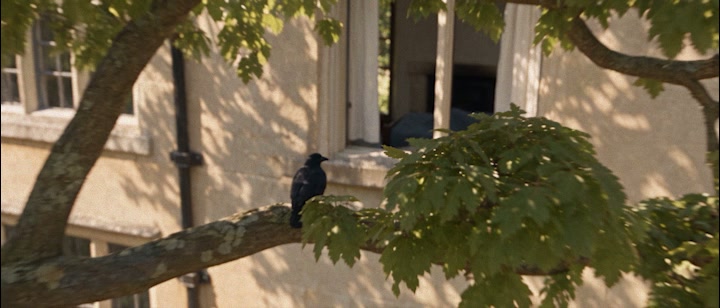
The movement descends from the clouds towards a treetop, a pale stone house, and an open window. A black bird sits on a branch. The camera passes close by and approaches the room. The movement feels like a single flight through the air: sky, tree, façade, and bedroom become parts of one permeable space.
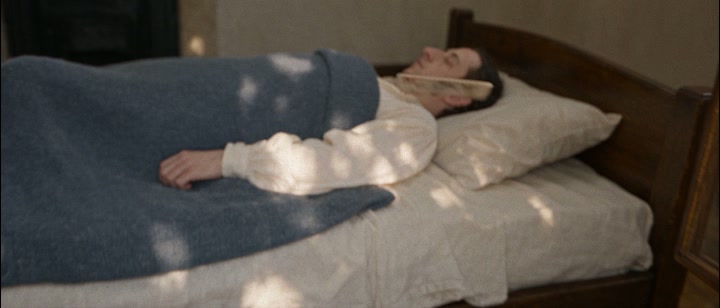
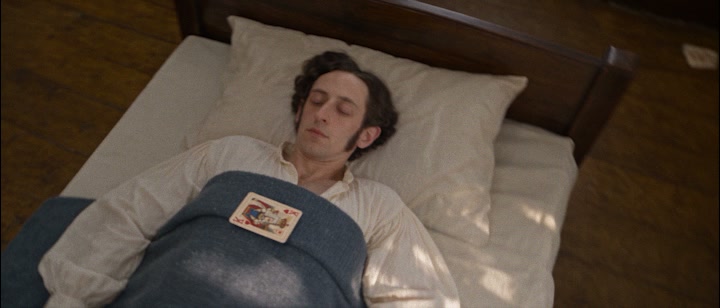
A bed appears through white curtains. The storyteller from the historical strand sleeps in a pale shirt beneath a blue blanket. Cards lie on a small table or a surface beside the window. A movement of air lifts one; it turns over and settles on his chest.
The camera passes over the bed, changing direction and approaching an overhead angle. The sleeper remains the axis of this gentle turn. Light travels through foliage, drawing moving patches on the white linen and blue fabric. The card on his chest is a small material remnant of a large adventure.
This is a fundamental shift in the scale of authorship. We have followed Alice making a film; now her world is discovered within the storyteller's dream. Yet “it was all only a dream” is insufficient here: fantasy has already entered the framing scene in the boat, and the Rabbit will still appear in the garden. The film proposes a chain of mutual dreams and stories, rather than a single final container for reality.
The Storyteller Receives His Story
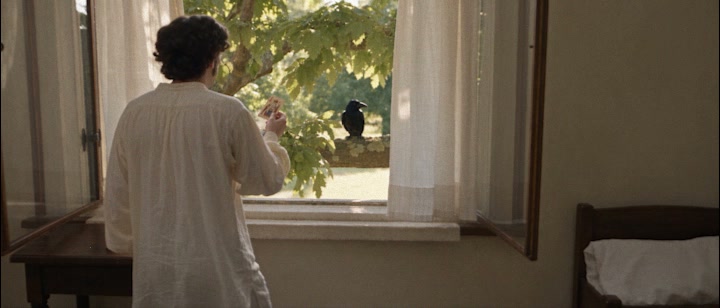
The man wakes, takes the card, sits up, and studies it for a while. The pause matters: the object holds a remnant of the dream that has not yet become words. He then turns towards the window and rises. The camera is behind him, making the bright rectangle the direction of both his gaze and his thoughts.
“Oh, I've had such a curious dream.” His movements contain none of the panic that follows a nightmare. On the contrary, his awakening attention gradually becomes pleasure. He turns his head and body, smiles, and says that the Liddell girls will be delighted.
In this line, the storyteller acquires Carroll's historical identity. Together with the opening date and the closing dedication, it connects the film to the birth of Alice. This adult does not demand an end to nonsense. He is ready to remember it and pass it on to children.
After he leaves the central part of the frame, the camera moves towards the window again, passing the curtain and branch to reveal the garden. The film's first major transition led from a story to a young filmmaker; its last returns her adventure to someone who is only about to become a storyteller. This does not cancel her authorship but creates a loop: one author imagines another author, who also imagines a world.
A Dedication and Reality's Last Objection
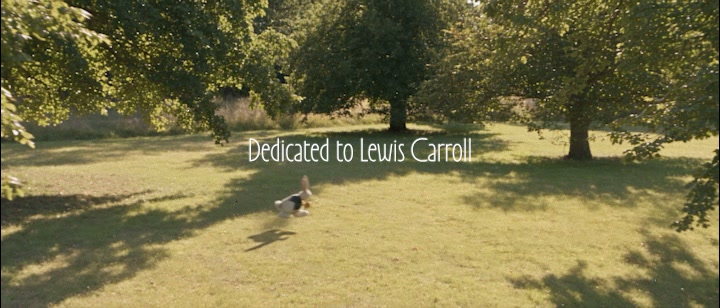
“Dedicated to Lewis Carroll” appears over a sunlit lawn. Branches clear the foreground and the space opens out. There is plenty of air; green and gold replace all the earlier aggressive combinations. After metal, court cards, barriers, and interfaces, the film leaves us with a simple garden.
Yet a small, clothed White Rabbit runs across the grass. He crosses the space beneath the dedication, and this detail prevents the story from closing with an everyday explanation. The storyteller has woken, but the character is still moving outside his room. Reality has not regained complete control.
This is the picture's final gesture, not incidental background for an inscription. The dedication names its literary interlocutor; the Rabbit confirms the enduring life of his world.
Sound and Speech: How the Story Is Told
Dialogue in Al!CE does more than explain what is happening. Lines move from one world to another, return with new meanings, and shape the transitions between scenes. Musical numbers, domestic arguments, and fairy-tale formulas become a story about who gets to speak—and whose wishes others are prepared to hear.
Permission to tell a story. In the boat, the dialogue takes the form of a promise and a commission: an adult offers a story, and a child specifies how unusual it should be. The listener can influence the work before it begins. The story emerges from an exchange rather than an adult's monologue.
A command and a musical action. “Rolling... Action!” connects two authorial roles: the storyteller begins a story, and Alice begins a shoot. The characters perform the rap within the scene; the heroine then works with that same performance on a screen. Tweedledum and Tweedledee's childish verbal dispute takes the contemporary form of a rap battle, while the musical number becomes material for another work.
From restriction to literal metaphor. “Out of credits,” the father's prohibition, and the demand to grow up form a succession of verbal blows. The line about her own tears follows. Words that previously limited action give way to an image of feeling: the room becomes a sea. Alice's self-directed irony restores her ability to name and make sense of what has happened.
Repetition as a bridge between scenes. The child's “I want more nonsense!” is repeated by modern Alice, who then adds “And money.” This is the film's central sound rhyme. The phrase stays the same; the speaker's age, circumstances, and the cost of her wish change. A single verbal construction connects the two Alices, while the added words turn the pleasure of a fairy tale into a question about the resources needed to create one.
Conversation and vision. In the club, dialogue introduces a potential investor and gives the heroine a new route to follow. Conversation then gives way to free fantasy: the mushroom, smoke, elongated neck, ceremony, and Rabbit Herald no longer need explanation. For a moment, the search for a useful contact opens into a dream of recognition.
A conversation that cannot keep up with movement. “Do you invest in films?”—“Walk and talk.”—“I just need—”. Action cuts the line short. The canonical “Curiouser and curiouser” soon gives way to the everyday “Ugh, not school again.” These are two vocabularies belonging to one heroine: literary wonder and contemporary irritation.
The flowers' musical number. The advice about running and standing still is divided among several voices. Words pass from one floral mouth to another, and the editing of the ensemble becomes the visible mechanism of the song. Rooted creatures teach speed to someone already tired of running. Alice's brief “Obviously” ends the number with a comic reply and returns the action to her practical goal.
An economic loop. “How much has it made?”—“It's not finished yet.”—“Come back when it has.” Speech constructs the trap itself; no further explanation is needed. The repeated “You need to grow up” links the Rabbit to the father and turns the business meeting into a variation on the conflict at home.
A bureaucratic loop. “We'll discuss it at the next meeting.”—“And when's that?”—“When this one's over.” What repeats is the syntax of postponement, rather than a particular phrase. The first conversation withholds money until success; the second withholds a decision until an endless process is complete. Nonsense is expressed in grammatically precise, outwardly reasonable speech.
Action replaces a request. “All in” accompanies the movement of the chips. The announced hand and Humpty Dumpty's answering look turn the line into an event. The verbal resolve is clearer here than the literal logic of the cards: what matters is that Alice makes her own move after a series of conversations in which others set the terms.
An ordinary conversation after the adventure. On the bench, the heroine no longer makes another request. She announces that her film will continue and imagines its future story. The quiet form of the conversation changes the meaning of victory: the everyday pleasure of working and imagining is available to her again.
Speech frees the camera. Alice's final line continues over the sky, maintaining a connection to her as the image moves away. Then a new speaker appears, with words about a curious dream. The story passes from one author to another: dialogue, a glance, and camera movement connect the contemporary filmmaker to the future storyteller.
Colour, Light, and Costume as a Single Score
The film does not maintain one palette; it passes Alice from one system of colour to another. Continuity nevertheless holds: blue, green, white, and red return in different materials. The historical girl's blue dress echoes in the turquoise outfit beside the limousine and the pale-blue casino costume. The river's greenery passes into the Caterpillar's body, the park, the baize, and the checks of the final pinafore dress. Red appears as a sash, lapels, a mushroom, a flower, a card suit, and a chip.
| Setting | Colour and light | Their role in the scene |
|---|---|---|
| River and boat | Grey-green water, peach sky, atmospheric haze | Create the distance of memory and the gentleness of the opening story |
| Waterfront and overpass | Blue daylight, concrete, red hair, a turquoise T-shirt, gold | Set the energy of the screen image against the material conditions of filming |
| Bedroom | Mustard-gold light, olive walls, white clothing | Maintain outward warmth during an inner conflict; the water then doubles the light |
| Interface | Graphite and acid yellow | Introduce a concrete signal of access: clicking is possible, continuing without money is not |
| Club | Purple, blue, red, glossy green | Make fairy-tale excess the setting for connections and promises |
| Street and manhole | Cream fabric against the grey city, orange barriers | Show the vulnerability of fantasy within urban infrastructure |
| Flowers | Black outfit, grey asphalt, accents of pink, white, yellow, and violet | Define a small island of living fairy tale while preserving Alice's distance from this chorus |
| Limousine | Glossy black surfaces and leather, white fur, vivid turquoise | Combine status, exclusivity, and the heroine's attempt to appear convincing |
| Tea party | White, blue ornament, silver tableware, greenery | Disguise exclusion and senseless authority beneath cultural abundance |
| Casino | Green baize, amber lamps, the cool gleam of the fittings | Turn a request for access into a game and a risk |
| Final park and bedroom | Foliage, patches of sunlight, milky-white linen, a blue blanket | Restore freedom to air and light after the enclosed interiors |
Alice's costumes form a sequence of ways to present herself to the world. The cap and jacket express independence at work. White clothes at home suggest defences removed. Checks and lace at the club attempt to combine seriousness with a willingness to join someone else's game. The cream dress makes a fairy-tale appearance on an ordinary pavement. The black outfit after the fall brings graphic sharpness. Turquoise fans display scale before the investor. The blue-and-white pattern at tea signals membership of a cultural ritual. The gleaming casino trim marks participation in a public wager. The final pinafore dress returns her to her own everyday life.
Not every change of clothes receives an everyday explanation. This matters: the film treats the wardrobe as a language of editing rather than a continuous state of affairs. Changing a costume here is roughly equivalent to changing the genre of the next scene. The transition from black to turquoise makes this especially clear: a principle usually kept hidden becomes a visible action.
Light also changes its function. In the boat, it unifies. Beneath the overpass, it separates the polished presentation from what lies behind it. In the bedroom, it creates an appearance of safety that the conversation destroys. In the flood, it becomes a substance. In the club, it breaks the space into seductive zones of colour. At the end, it passes through a tree and connects the room to the garden. This final kind of light does not require the characters to pose: it exists alongside them.
What It Resembles—and Why
Carroll and Tenniel: a shared world spanning two books. The White Rabbit, sea of tears, Caterpillar, tea party, and Cheshire Cat connect the film to Alice's Adventures in Wonderland. The talking flowers, Tweedledum and Tweedledee, Humpty Dumpty, and the rule of running twice as fast extend its material towards Through the Looking-Glass. It is therefore more accurate to describe the film as a free composition drawing on both books. The herald's silhouette, the Hatter's top hat, and animals in human clothes preserve a recognisable illustrative vocabulary associated with Tenniel's tradition. The literary sources are Alice's Adventures in Wonderland and Through the Looking-Glass.
Annie Leibovitz and Grace Coddington's fashion fairy tale. The closest useful parallel is the “Alice in Wonderland” shoot for Vogue, published in December 2003. The affinity lies in turning fairy-tale episodes into distinct costume worlds: clothing supports a role, and the fantastic surroundings become a set. This compares how the images are constructed; it does not claim matching dresses, models, or direct quotation. The parallel can be seen in Vogue's republication of the series.
Tim Walker: an object that becomes a world. A mushroom becomes furniture, a puffer jacket becomes anatomy, and the folds of a dress become an event. It is precisely this movement from costume and props towards an entire fantastic environment that recalls Walker's photographs and scenic worlds. Not every bright costume automatically “looks like Walker”; the resemblance is more convincing when an object ceases to be decoration and begins to change human scale. On his work with objects, fashion, and fantastic spaces: V&A, Tim Walker: Wonderful Things.
Magritte: impossibility presented as the normal state of things. The taxi in the river and the little king in a palm are not surrounded by explanatory devices. The object remains recognisable while its relationship to its surroundings changes. This logic resembles the surrealist displacement of the familiar: changes in scale and juxtaposition make everyday life enigmatic. The affinity concerns how the image works, leaving the question of direct influence open. A similar principle is explored in MoMA on Magritte and SFMOMA, Personal Values.
Music video, fashion film, and social comedy. The inverted horizon, rapid blurred shifts of attention, push into the phone, costume changes, and conspicuous colour accents have affinities with music-video editing. But Alice's recurring goal and repeated lines give this structure a plot. At its best, an effect does more than surprise: flooding makes a feeling visible, an expanding body expresses the inaccessibility of help, and the river with its taxi reveals how permeable the story is. This causal connection between an effect and a character's state distinguishes these scenes from a random collection of beautiful transformations.
What Is Most Expressive—and What Remains Ambiguous
The strongest thread running through the film is the repetition of a request across different worlds. Alice asks the performers for another take, her father not to stop her, the Caterpillar for direction, the Rabbit for investment, the government for credits, and the King for permission to act. The setting changes, but her position as a petitioner remains. Only going all in shifts her from asking to taking a risk of her own. Its merits as a solution to a financial problem are debatable, but the transition is clear as an expression of character.
The work with reactions is equally important. The historical girl more often opens herself to wonder: a smile, a lifted torso, a wide-open mouth. Modern Alice more often tests wonder for its usefulness: narrowed eyes, a sideways glance, a tense question, a short, weary reply. Yet she does not become a cynic. On the bench, her face turns towards the sun again, and her thoughts towards a new film. Her capacity to look beyond the obstacle returns.
The most precise visual transitions draw on properties that things share. Water connects the room and the river. The phone screen, the reflection in the eyes, and the laptop connect filming to image creation. The Cat's green turns into green baize. The authority of the cards returns as a card on the sleeping man's chest. In these instances, editing does more than take us to a new location: it carries meaning through material.
The brief royal vision and the outcome of the card game are more open to different readings. The first creates a powerful image of possible recognition without explaining its literal status. The second provides a clear gesture of resolve and an expressive reaction from Humpty Dumpty, but leaves the transition from the game to actual funding off screen. These omissions sustain the logic of a dream; at the same time, they make the heroine's practical victory less certain. The ambiguity both feeds the freedom of fantasy and weakens the everyday plausibility of the resolution.
The final dream should not be closed down to a single explanation either. It can be read as returning the whole story to Carroll. Or as the author and character imagining one another. Or as a joke about how every new storytelling technology is still in conversation with older literature. The running Rabbit leaves room for all these versions: the source of the fantasy has been found, but the fantasy itself has not been caught.
To describe the film in one extended image, it is the story of a young woman carrying unfinished cinema through a world of ready-made roles. The father knows what a daughter should be. The investor knows what a project should be. The Hatter knows who has the right to sit at the table. The flowers know how to run. Alice is always slightly the wrong person, slightly mistimed, and slightly in the wrong outfit. Her persistence lies in refusing to accept this mismatch as a verdict. When she says she will continue the film, the essential work is already done: other people's rules have become her material.